- DiggerInsights
- Posts
- The Reactor That Runs on the Waste From Other Reactors
The Reactor That Runs on the Waste From Other Reactors
A startup is building a power plant that fits in a warehouse and runs on nuclear waste. The US hasn't built a new reactor design in 40 years.

Digby the Digger ⛏️
March 26, 2026

Nuclear Reactor
What if the most dangerous stuff in the world was also free fuel?
That's the premise behind a startup most people outside energy circles haven't heard of yet. They're building a nuclear power plant small enough to fit inside a warehouse, and they plan to run it on the stuff nuclear plants have been burying in concrete for decades.
Meet Oklo, the advanced nuclear company that might have found the most elegant answer to the hardest problem in energy.
The Founder
Jake DeWitte grew up doing what most kids don't do on road trips.
He'd drag his family past national parks and into nuclear plant parking lots. In Albuquerque, he read every library book on fission he could find. He wrote letters to the creators of Sim City to tell them they'd depicted nuclear plants incorrectly. He spent high school book reports on reactor design.
By the time he got to MIT for his PhD in nuclear engineering, he'd already worked at a DOE national lab and at GE's nuclear division. Both left him with the same conclusion: government labs move too slow. Big companies aren't aggressive enough. The next generation of nuclear isn't going to come from either.
So in 2013, he left MIT without finishing his PhD, and co-founded Oklo with Caroline Cochran, his MIT classmate. They applied to Y Combinator. A nuclear startup, at YC. That tells you something about how serious this was. They started building.
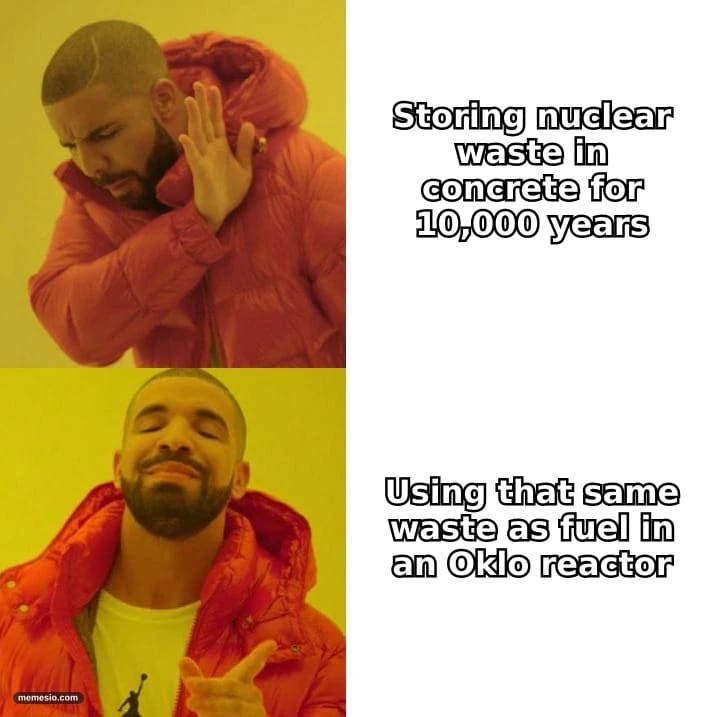
The founding insight was simple: the US has spent 60 years and $50 billion trying to figure out what to do with nuclear waste. Oklo's answer was: use it.
How It Works
Imagine you're burning wood in a fireplace. Standard nuclear reactors are like that: you put in fuel, get heat, and are left with ash. But Oklo built a different kind of fire.
Their Aurora powerhouse is a fast-neutron reactor. In nuclear terminology, "fast" means the neutrons are moving much quicker than in a conventional design. And faster neutrons can do something slow ones can't: they can fission the "ash." The material that conventional reactors spit out as waste, the used fuel, the transuranic elements, fast neutrons can crack those open and extract 90%+ of the remaining energy inside them.
It's not burning the wood. It's burning the charcoal left over after everyone else is done.
The Aurora is compact: roughly 50 megawatts, enough to power about 40,000 homes. It's liquid-metal cooled (sodium), which means it operates at lower pressure than conventional reactors and has passive safety systems. No active pumps needed to prevent meltdown. Physics does the work.
The business model is unusual too. Oklo doesn't sell reactors. They sell electricity. Build, Own, Operate. Like a cloud company selling compute instead of servers.
Who's Buying
The customers already signing up:
Data centers are the obvious first market. AI infrastructure needs reliable, always-on, carbon-free power. Solar and wind don't cut it when your GPU cluster can't afford downtime. Oklo has a landmark partnership with Meta and has been in early discussions with military installations (the US Air Force issued a Notice of Intent to Award for the first advanced fission deployment at a military base).
Defense sites, remote industrial operations, universities, utilities. Anywhere you need baseload power and can't afford to be at the mercy of a grid. Or a strait.
The Catch
Here's what's genuinely unproven, and it's significant.
Oklo has never operated a commercial reactor. Not one. Their 2020 application for a Combined Operating License from the NRC was rejected in January 2022, a rare and embarrassing outcome, because Oklo couldn't provide a detailed enough safety methodology for the NRC's reviewers. They had to restart the licensing process from scratch.
The resubmission is moving through the NRC now, and March 2026 marks real progress: the DOE approved the Nuclear Safety Design Agreement (NSDA) for the first Aurora reactor at Idaho National Laboratory on March 17, 2026, under its Reactor Pilot Program (source: Oklo press release, March 17, 2026). Oklo immediately requested DOE begin review of its Preliminary Documented Safety Analysis. But the path from "safety design approval" to "commercially licensed, generating revenue" involves layers of regulatory review that the US hasn't practiced in decades. The NRC isn't slow because it's broken. It's slow because it's building the review infrastructure for reactor designs that didn't exist when the last set of rules was written.
The first reactor isn't expected online until late 2027 or early 2028. Revenue before then: essentially zero.
The Signal
The people writing checks are not random.
Oklo went public in May 2024 via SPAC merger with AltC Acquisition Corp, a blank-check company co-founded by Sam Altman, who now chairs Oklo's board. Altman has been explicit about why: nuclear is the only realistic energy source that can power civilization-scale AI compute. The SPAC brought in $306 million in gross proceeds.
The DOE has committed $2 billion in support for US nuclear fuel development tied to Oklo's supply chain work. Oklo's fuel recycling facility in Oak Ridge, Tennessee just broke ground. It's the first privately funded commercial-scale electrochemical recycling operation in US history. The company's contracted pipeline stands at 14 gigawatts of future power agreements.
NuScale (water-cooled SMR) stumbled badly in 2023 when its flagship project was cancelled and its stock cratered 35%. Oklo's differentiation is real: waste-as-fuel, faster-neutron design, fully vertically integrated from recycling to generation. TerraPower (Bill Gates), X-energy, and Kairos Power are all racing toward the same market. But only Oklo is betting that the fuel problem and the waste problem are the same problem.
That's either a stroke of genius or an enormous amount of regulatory surface area to manage simultaneously.
Close
Jake DeWitte spent an hour in a parking lot as a kid, staring at a building he couldn't get into.
Twelve years after leaving MIT to build the thing instead of studying it, his company just got permission to break ground. The world's fossil fuel supply chains are visibly cracking. The timing is either lucky or inevitable.
Worth watching: whether Oklo can do in three years what the US nuclear industry hasn't done in 40.
📊 Quick Stats
SPAC proceeds (May 2024): $306M gross via AltC Acquisition Corp merger
DOE commitment: $2B in support for US nuclear fuel development tied to Oklo's supply chain
Contracted pipeline: 14 GW of future power agreements
First reactor timeline: Late 2027 / early 2028 (Aurora at Idaho National Laboratory)
DOE NSDA approval: March 17, 2026 (Nuclear Safety Design Agreement for Aurora)
Fuel recycling: First privately funded commercial-scale electrochemical recycling facility, Oak Ridge, TN (broke ground 2025)
Board chair: Sam Altman (co-founded the SPAC vehicle)
NuScale comparison: Stock cratered ~35% in 2023 after flagship Utah UAMPS project cancelled; water-cooled SMR, different tech approach
Competitor funding context: TerraPower (Bill Gates) raised $750M+; X-energy raised $400M+; Kairos Power signed Google PPA for SMRs by 2030
Oklo differentiation: Only company betting that the fuel problem and the waste problem are the same problem
💼 Jobs Worth Digging Into
Real frontier roles in nuclear and advanced energy:
1. Oklo | Senior Nuclear Engineer, Aurora Powerhouse Help design the first privately built advanced fission reactor in modern US history. 📍 Santa Clara, CA / Idaho Falls, ID 🔗 oklo.com/careers
2. TerraPower | Reactor Physicist, Natrium Program Bill Gates' sodium-cooled reactor just got US construction approval. Model the physics of a reactor no one has built yet. 📍 Bellevue, WA 🔗 terrapower.com/careers
3. Kairos Power | Control Systems Engineer, Fluoride Salt-Cooled Reactor Google signed a power purchase agreement with them for SMRs by 2030. Now they need to actually build them. 📍 Alameda, CA 🔗 kairospower.com/careers
4. X-energy | Fuel Fabrication Engineer, TRISO Fuel Their pebble-bed reactor uses fuel that literally can't melt down: the pellets are coated at 3000°F. Make the pellets. 📍 Rockville, MD 🔗 x-energy.com/careers
🐸 Memes


DiggerInsights drops every Tuesday and Thursday. Share it with one curious person this week. Dug up with a headlamp and genuine alarm ⛏️
Reply